In Part 1 of Who Are You?, I took you along on my journey of questioning myself and my sense of identity as the life I’d known began changing.
I used the metaphor of a pendulum to describe those unsettling feelings. It was a pendulum that had been swinging steadily for years, suddenly disturbed by life’s changing circumstances.
But there was something strangely familiar about those feelings. They reminded me of my teenage years, when life was full of uncertainty and I was still figuring out who I was.
And I eventually realised, perhaps I wasn’t lost after all.
But as I discovered, questioning who I was turned out to be a rather complicated process!
How about you?
When you think back to where you began your adult life, who were you becoming?
And what aspirations drove your internal world?
Was it a career, motherhood, homemaking, caring for others, studying for a degree or pursuing a profession? Or was there something else you began living for, day in and day out?
And before you knew it, had you also completely nestled into your adult life, living the very life you’d created for yourself?
I know I did. I thought that was going to be my life forever. I couldn’t imagine a future that looked any different.
I had created a life for myself, and all I had to do was live it.
But time has a way of mixing things up for us just when we are content and used to living that way of life.
And this is what can disturb our sense of self, our identity and our understanding of who we’ve become over all these years. Our lives have shaped how we see ourselves and how we assume others see us as well.
Think of an Olympian athlete. They may have started their life’s trajectory as early as their teenage years. Whether they chose it for themselves or not, they started their path to identity way back then.
They trained ridiculously hard in extraordinary routines for the years and years and years. It was what they lived for. It became all they knew. It was who they were.
An identity.
Think of a young couple. They get married, perhaps have children, build careers, become part of their community and create a home with the white picket fence.
They live for the world they’ve created, and over time, they too become the very people within it. Because that’s the life they know, and who they’ve come to believe they are.
Apply this very same principle to an academic, a tradesperson, a farmer, a traveller, a pioneer, or someone pursuing any other path in life.
Their sense of self and identity can become deeply connected to the person they’ve spent years becoming.
We spend decades repeating the same patterns, building upon the lives we’ve created and becoming known for the people we are within them. We keep doing what we do, striving for what we’ve always strived for, and become better at the roles we’ve taken on.
And somewhere along the way, without even realising it, all that repetition, continuity and recognition becomes deeply ingrained in us. It’s what we know, it’s what we do, and it’s what we focus on.
We have become who we became.
Our sense of identity can become so entwined with our circumstances that we struggle to recognise ourselves without them.
So, what happens when the life you’ve occupied for the past 30 years starts changing, a lot?
And this is exactly what was happening to me. My world had changed in so many ways that I began questioning myself. Who was I anymore? Had I somehow become lost?
Last week, through the pendulum metaphor, I came to the realisation that perhaps I wasn’t lost after all.
And if I were to ask myself now, “Who are you?”, my answer would be simple.
Me. I’m still me.
So why did that whole experience unsettle me so much?
Why was I faced with considering the possibility of a midlife crisis, or that I was somehow lost?
And why do we see headlines everywhere such as: Finding yourself again, coming home to you, or returning to you, and the phrase… becoming?
Because these feelings are real. They’re something many of us experience at different stages of life, and midlife is certainly one of them.
One crucial part of these conversations isn’t spoken about nearly enough, and that is the why.
Because, how are we supposed to figure something out as significant as this when we don’t really understand why it happens in the first place?
Does anybody ever really know?
I don’t think it is something we bring upon ourselves.
And I don’t think it happens in isolation either.
The more I think about it, I am noticing that it’s not even all about identity, which is what social media may lead you to believe.
Hear me out, I’ll paint a picture of what I believe may be happening when we start questioning ourselves and our lives in midlife. Purely speaking from my own experience.
When we reach our 40s and 50s, for many of us, we have any number of things beginning to influence our lives.
We may be transitioning to an empty nest, or slowing down in a career, maybe even downsizing, or all of the above… and they are pretty big changes of circumstances.
We may also be experiencing ageing bodies, or onset of illnesses, changes in our health and over all physical endurance and capabilities.
Mentally and emotionally, we may not have the same capacity we once had, we may be tired, exhausted and overwhelmed.
Relationships can change as our lives transition from previous circumstances. Our connections can change and how we feel about them can also change.
Financial limitations may arise, or other costs arise due to our changing environments.
Perimenopause or menopause may also be on the scene, bringing hormonal changes that can influence how we feel physically, mentally and emotionally. Something I don’t think we give ourselves nearly enough credit for.
Any of these things alone can make us feel unsettled, but when we add them all together, it creates a perfect storm.
I’ve come to realise this is a much bigger and broader picture than we may have thought.
And I think that’s why I find myself asking: Why are we so quick to frame this period of life as a crisis, a loss, or something we need to recover from?
Because now, our responsibilities and circumstances are changing, and our bodies and minds are changing, and we can easily interpret these unsettling feelings through whatever narrative we are being exposed to.
And social media is full of them…
You’re lost.
You’ve forgotten who you are.
You need to rediscover yourself.
It’s time to become the woman you were meant to be.
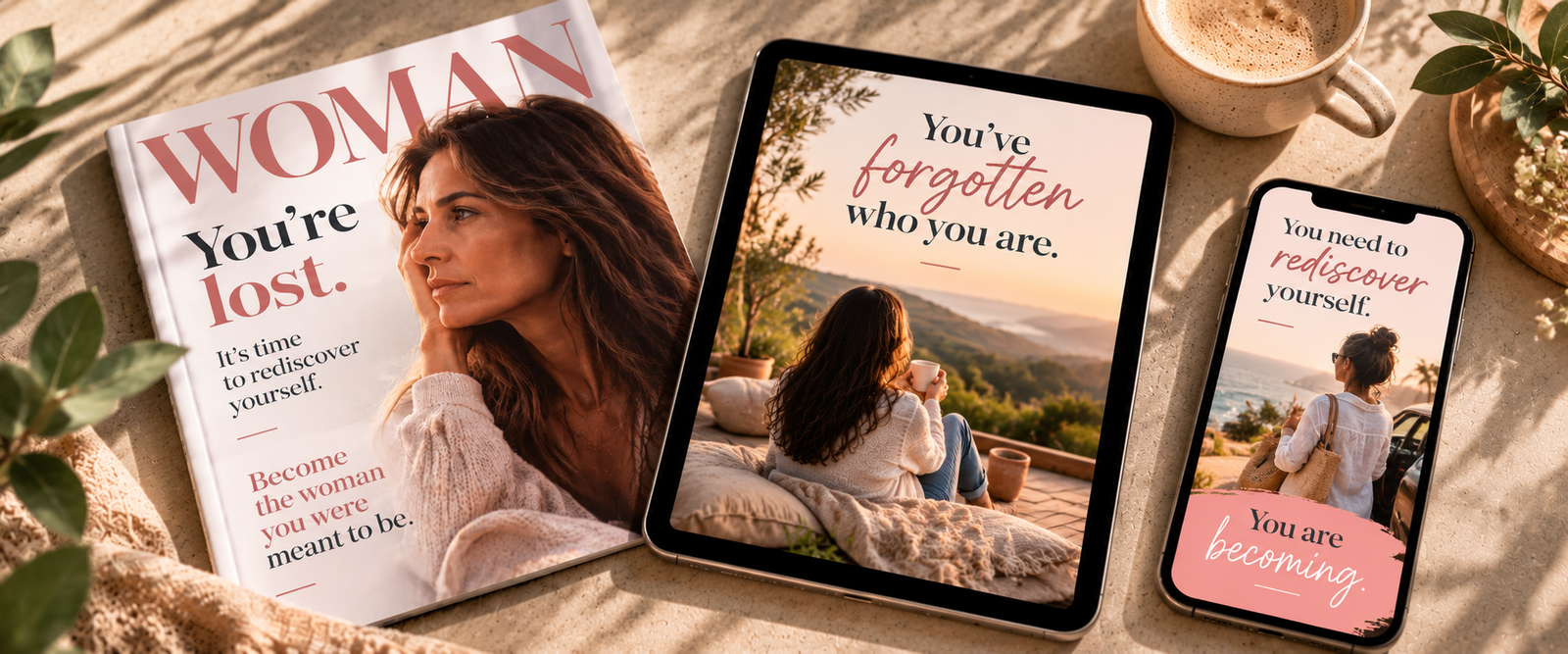
And all of these messages can be very validating. Some may even feel true.
But when we’re already feeling uncertain and vulnerable, those messages can add to the unsettling feelings we’re experiencing. We may even begin interpreting those feelings as a sign that something is fundamentally wrong.
But what if we gave ourselves the opportunity to understand the bigger picture first?
What if we recognised that the life we’ve spent decades building isn’t necessarily gone, but has simply entered a new era?
And what if, instead of immediately mourning the person we used to be, we could also celebrate everything that we had accomplished?
Understanding all of this doesn’t automatically solve everything. But it does give us context, and context can make an experience feel much less frightening.
Having more context may open up new possibilities that you may not have had the room for before…
Maybe there are things you always wanted to do but couldn’t.
Maybe there are interests you put aside.
Maybe there were places you’d wished to visit, but they were totally out of reach.
And perhaps some of the responsibilities that once consumed your time have eased, or your priorities have changed. You may now have opportunities to explore and experiment in ways you couldn’t before.
And none of these choices require a new identity.
They require the freedom to consider what you want next…
Reframing the narrative can give us that freedom, clarity and a new perspective on midlife and beyond.
And I think this is what I’ve come to understand through my own experience.
Just because the life we’ve known forever begins to change, it doesn’t necessarily mean we’ve lost who we are.
I believe we’re simply adjusting to a different way of living. One that no longer looks quite like the life we’ve become so familiar with.
And of course that can feel unsettling! We’ve spent years, decades, knowing what our lives looked like, what was expected of us, and where we fitted into it all.
But change doesn’t automatically mean loss. Sometimes it means adapting, making room for different priorities, and discovering what possibilities our changing circumstances might now allow us.
And after everything we’ve spent our lives building, learning and experiencing, I think we’ve earned the opportunity to explore what comes next.
It should feel exciting, earned and unapologetically invigorating.
Not fear. Not urgency. Not doubt. And not necessarily a loss of identity.
Because I believe I am still me.
And you are still you.